May 4, 2026 · 5 min read
Do I Need a Prior Art Search Before Launching My SaaS?
Most indie SaaS founders don't need a $5K prior art search before launch — but ignoring patents entirely can trigger treble damages. Here's the line.
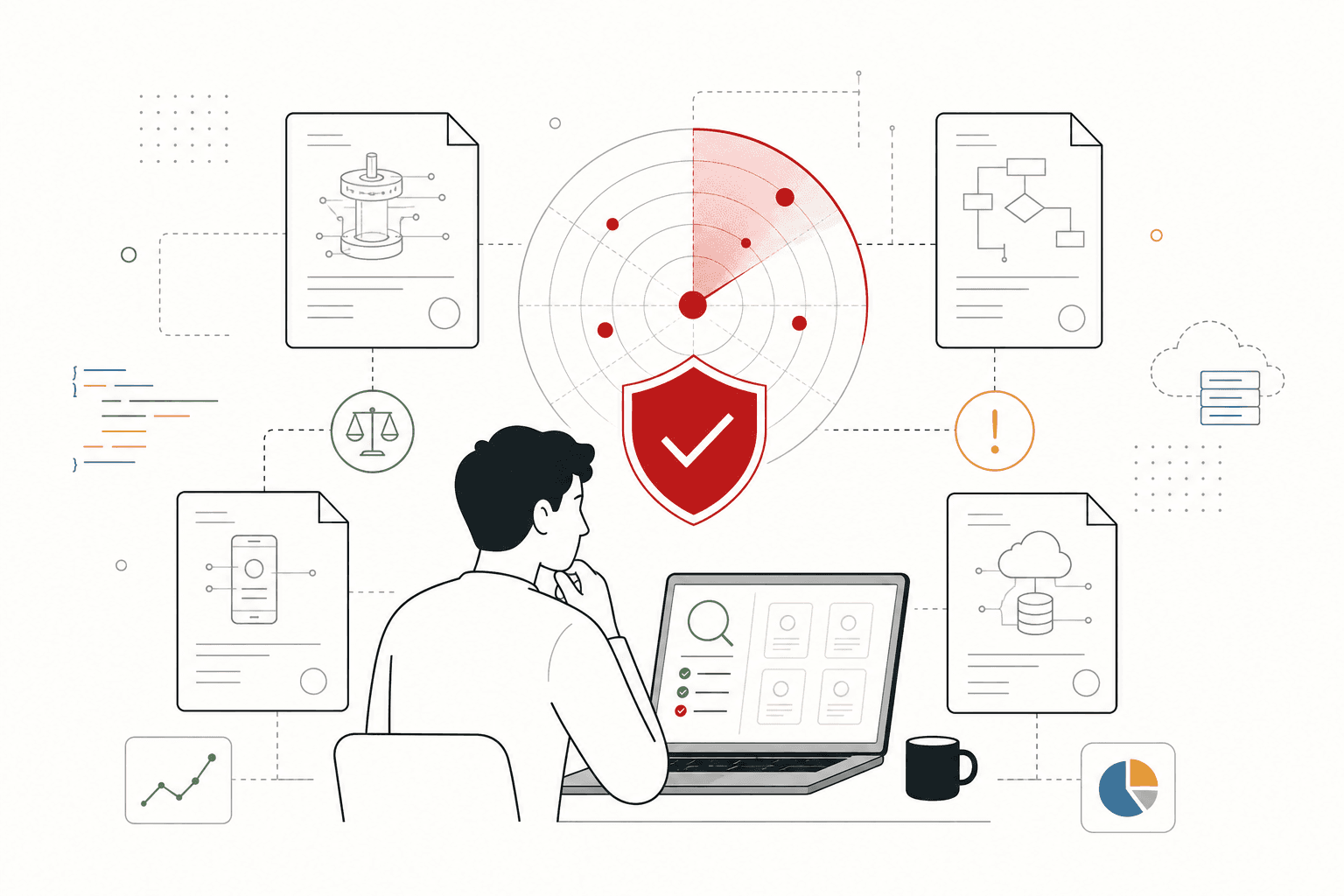
The bottom line: If you're a pre-revenue or sub-$500K-ARR indie SaaS founder, you don't need a $5,000 prior art search before launch — but you do need a passive watch on your space. The risk that justifies action isn't filing your own patent; it's becoming a knowing infringer of someone else's.
This post explains exactly when each level of effort is worth it, with citations to the federal statutes that make this calculation real.
What is a prior art search, exactly?
A prior art search is the process of finding any publicly disclosed invention — patents, published applications, academic papers, product manuals, conference talks — that overlaps with the technology you're shipping or trying to patent.
The output is a list of "references" with one of three labels:
- Anticipating — the prior art covers your invention completely. You can't patent it, and you may be infringing if you ship it.
- Obvious in light of — combining two or three references would have been obvious to a person skilled in the field. Same legal effect for patentability under 35 U.S.C. § 103.
- Background — same domain, different mechanism. Useful context, no immediate legal risk.
Most indie founders read about prior art in the context of patent filing. But there are actually two distinct uses, and the second matters more:
- Patentability search — Will the USPTO grant me a patent? (Asked before filing.)
- Freedom-to-operate (FTO) search — Will I get sued if I ship this? (Asked before launch.)
If you're not filing, you can skip #1. You should never skip #2 entirely.
When you actually need a search vs. just monitoring
For most indie SaaS, the real decision is between:
- Doing nothing — risk = unknown, cost = $0
- Continuous monitoring — risk = manageable, cost = ~$30/month
- One-time formal search — risk = low for the moment of search, cost = $5K–$15K
- Ongoing FTO opinion from counsel — risk = lowest, cost = $20K+/year
The trap is treating these as equivalent. They aren't. A one-time formal search gives you a snapshot; six months later, three new patents may have been published in your space and you'd never know.
Here's a decision matrix:
| You are… | Recommended level |
|---|---|
| Pre-revenue, building in public, no investors | Continuous monitoring (sufficient for risk awareness) |
| Earning revenue, no priced round | Continuous monitoring + one targeted formal search before any major launch |
| Post-priced-round, raising more | Continuous monitoring + formal FTO opinion (your investors will likely require it) |
| Hardware, biotech, deep tech | Formal FTO opinion before first ship — exception to all of the above |
The "knowing infringer" trap
The reason "do nothing" is dangerous isn't that someone will randomly find you — it's that the standard for treble damages under 35 U.S.C. § 284 requires the patent holder to prove you knew about their patent and continued anyway.
Practically, this means:
- A competitor sends you a cease-and-desist letter. From that day on, ignoring it makes you a knowing infringer.
- An angel investor or acquirer asks "have you checked patents in this space?" and you say no — the Halo Electronics v. Pulse Electronics (Supreme Court, 2016) standard makes willful blindness a hazard.
- You read a Hacker News thread linking to a patent in your space, then ship the feature. That, too, can support a willfulness finding.
This is why merely monitoring — keeping a passive watch with risk-graded alerts — is so different from doing nothing. You're informed, but you have a documented evidence trail showing you took reasonable steps. Most cases don't reach willfulness territory, and most willfulness claims fail. But the cost of that defense is real.
What a passive monitoring system actually does
A continuous patent monitor watches new public patent filings in the USPTO and EPO, plus academic preprints and competitor SEC filings, against a description of your product. When it finds something, it ranks the match (low / medium / high) and tells you in plain language why it matters.
This buys you three things:
- Early warning — find a problematic patent six months before it gets cited at you.
- Legal cover — documented monthly reports show you're not willfully blind.
- Competitive intel — your competitor's patent applications often reveal their roadmap a year ahead of public launch.
PriorPatrol does this for $29/month. Google Patents and PQAI don't (they're one-shot search interfaces). PatSnap and The Lens do, but at $1,000–$5,000/year minimums.
The minimum viable IP defense for a solo founder
If you take nothing else from this post, do these three things this week:
- Write down your product's three core technical claims — in plain English, two sentences each.
- Run a one-time search on Google Patents with each claim's keywords. Read the top 10. Note any that look close.
- Set up monitoring — either PriorPatrol, a paid Google Alerts trick, or PQAI's free tier. Pick one and actually configure it.
Total time: 30 minutes. Total cost: $0–$29. Compared to the downside of treble damages on $500K of revenue, this is the cheapest insurance you'll ever buy.
FAQ
Do I legally have to do a prior art search before launching?
No. There's no statute that requires it. But if a competitor later proves you knew about their patent and continued anyway, you can be hit with treble damages under 35 U.S.C. § 284.
What if I'm not planning to file my own patent?
You still benefit from a passive watch. The risk is being sued, not failing to file. Knowing what's already patented in your space is defense, not offense.
How much does a real prior art search cost?
Boutique IP firms charge $5,000 to $15,000 per query. AI-assisted services like PQAI are free to $20/month, but they're one-shot searches — not continuous monitoring.
Can I just use Google Patents?
Yes for a one-time check, no for ongoing safety. Google Patents has no alerting, no relevance ranking against your specific product, and no cross-source coverage of arXiv or SEC filings.
When does a prior art search become essential?
Three triggers: (1) you're filing a patent, (2) you've raised a priced round and your investors are doing IP diligence, (3) you've received a cease-and-desist or your competitor is publicly aggressive about IP.
Want continuous patent monitoring without the $5K bill? Start a free PriorPatrol watchlist — 3 manual scans on us, no credit card. Upgrade to Solo for $29/month when you want unlimited weekly scanning.
This post is informational, not legal advice. For high-stakes decisions, consult a registered patent attorney.